
Cannabis in the Kitchen: Cooking with Cannabinoids

Sisters.News
Your Weekly Dose of Cannabis Education 🌿
🗣️ "Knowing yourself is the beginning of all wisdom."
— Aristotle
Cannabis in the Kitchen: Cooking with Cannabinoids 👩🍳
Tired of relying on sugary gummies, chocolates, or heavy brownies for your edible intake? Taking your cannabis consumption into your own kitchen allows you to create healthy, savory, and custom-dosed meals that fit your specific dietary needs.
Whether you want to drizzle infused olive oil over a summer salad or bake a batch of high-CBD muffins, cooking with cannabis is a rewarding skill. But before you just throw some flower into a pan, you need to understand the science of activation.
🔥 Step 1: Decarboxylation (The Golden Rule)
Eating raw cannabis flower will not get you high, nor will it provide the potent relief of THC or CBD.
In its raw, living form, cannabis produces THCA and CBDA (the acidic precursors). While these raw molecules have their own mild anti-inflammatory benefits, they must be converted into active THC and CBD to cross the blood-brain barrier. This process is called Decarboxylation, and it requires one thing: Heat.
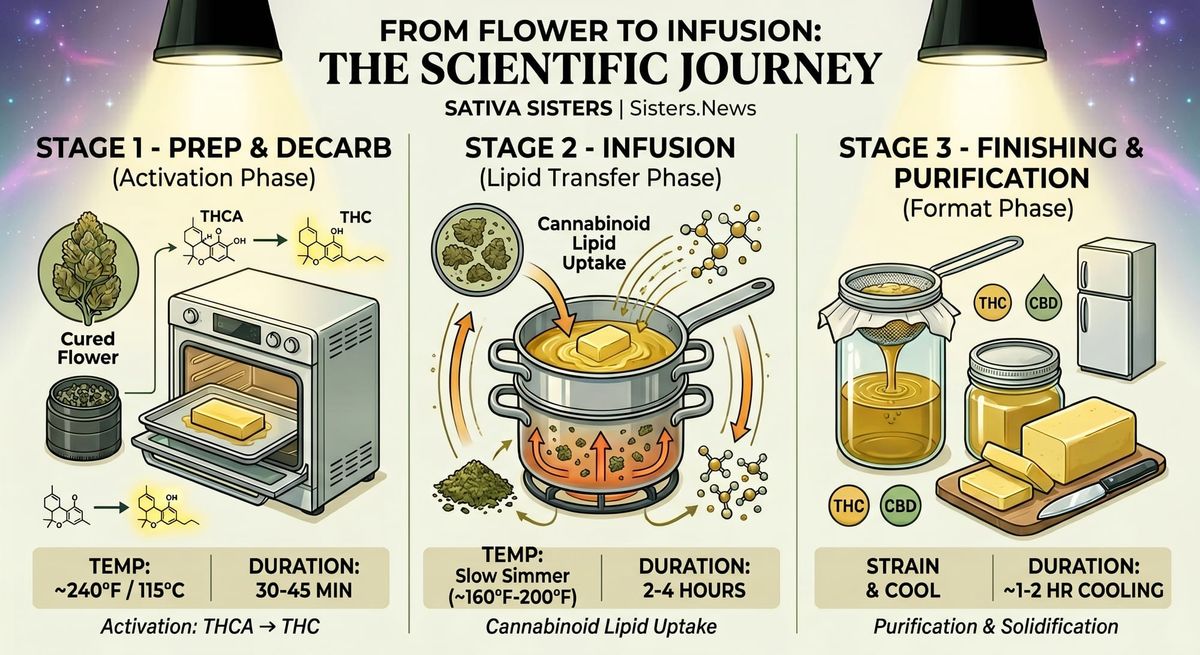
- The Process: Grind your flower loosely, spread it on a parchment-lined baking sheet, and bake it at 240°F for roughly 30 to 40 minutes.
- The Result: The heat breaks off a carboxyl ring from the molecules, officially activating your plant material and making it ready for infusion.
🧈 Step 2: The Fat Infusion
Cannabinoids are lipophilic, meaning they are fat-soluble. They will not bind to water, which is why making cannabis tea by just dropping buds in hot water doesn't work well.
To properly extract the activated cannabinoids, they need a carrier fat.
- Butter & Coconut Oil: These are the gold standards. Their high saturated fat content acts like a magnet, absorbing the maximum amount of THC and CBD during the infusion process.
- Olive Oil & Avocado Oil: Excellent for savory dishes, salad dressings, and low-heat cooking.
- The Method: Simmer your decarbed flower in your chosen fat on very low heat (around 160°F to 200°F) for 2 to 4 hours, then strain the plant material out using an ultra-fine cheesecloth.
🧮 The Dosing Dilemma & The "Cheat Code"
The hardest part of culinary cannabis is figuring out the potency. A homemade batch of brownies can easily become overwhelmingly strong if the infused butter isn't mixed perfectly evenly. Always eat a tiny test portion before consuming a full meal.
Want to skip the math, the baking, and the lingering smell of roasted cannabis in your house? Use the cheat code:
- Unflavored Tinctures: You can add a few precision drops of an unflavored MCT-oil tincture directly onto a plated meal (like a bowl of pasta or a slice of pizza) right before eating.
- RSO (Rick Simpson Oil): This fully activated, highly potent concentrate can be stirred directly into soups, sauces, or dressings with exact precision.
Try It Yourself!
Ready to don your chef's hat? Visit Sativa Sisters! If you want to make your infusions from scratch, our budtenders can point you toward the most flavorful, terpene-rich flower perfect for cooking. Prefer the cheat code? Ask us about our high-potency RSO syringes and unflavored wellness tinctures to instantly turn any meal into an infused masterpiece.


Next Week: Cannabis & Focus—Beating Brain Fog 🧠
Struggling to concentrate on your to-do list? Next week, we’ll explore the specific cannabinoids and terpenes that act as natural nootropics, helping to clear brain fog, boost memory retention, and lock you into a productive flow state.
This is for informational purposes only. For medical advice or diagnosis, consult a professional.